
Foundation Crack Repair Chicago
SEALED FOR GOOD, NOT PATCHED OVER
Polyurethane and epoxy injection that fills the full depth of the crack, seals the water pathway and bonds the concrete back to structural strength. Not a surface patch that fails by spring.
- Home
- Foundation Crack Repair
Not Every Crack Is Serious. Some Are.
A crack in a foundation wall causes more unnecessary panic and more dangerous complacency than anything else we get called about, because homeowners have no way to tell which kind they are looking at.
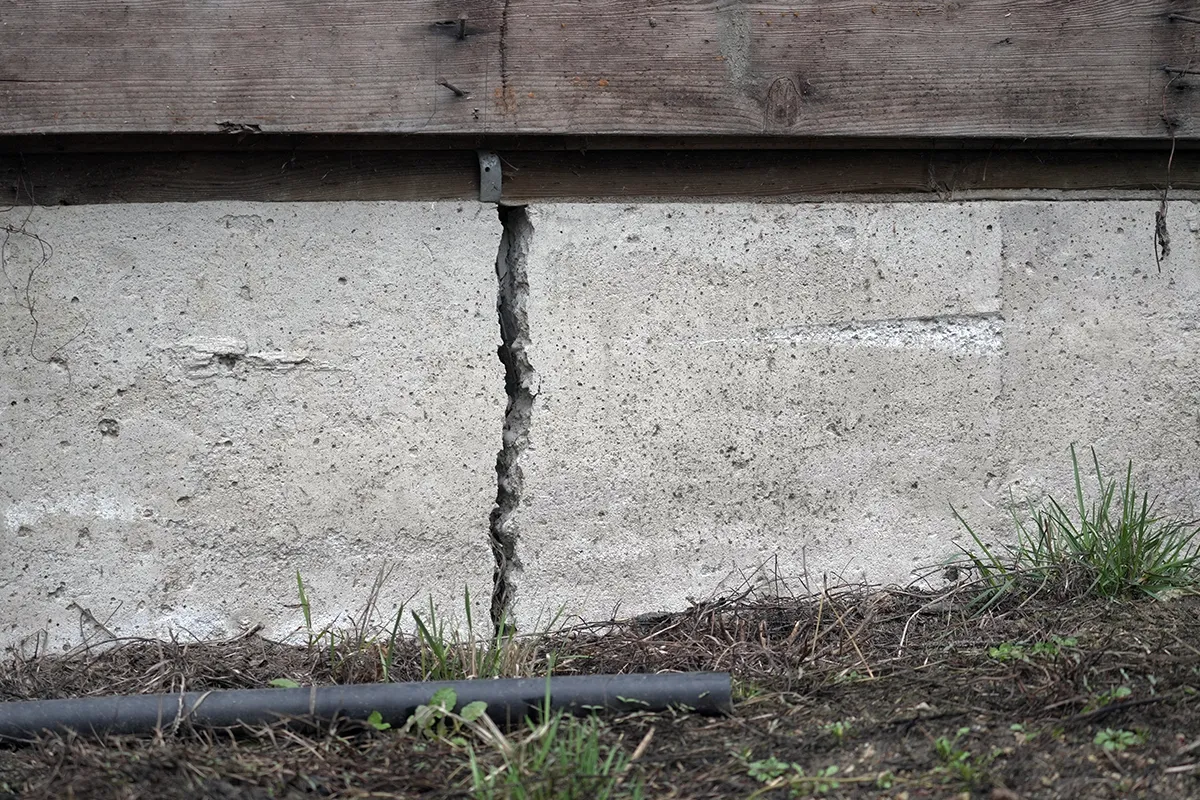
Most cracks in a poured concrete Chicago foundation are vertical, and most vertical cracks are shrinkage cracks from the concrete curing in its first year. They are extremely common, they are not structural, and they usually only matter because they let water in. Those get injected and sealed, and that is the end of it.
Horizontal cracks are a different conversation entirely. A horizontal crack running across a wall means soil pressure from outside has exceeded what the wall can resist. So does stair step cracking through block. Those walls are actively losing, they get worse every wet spring, and injection alone will not fix them because the force causing the crack is still there.
The repair method matters just as much as the diagnosis. A crack filled from the surface with hydraulic cement or caulk looks solved and typically fails within a season or two, because the crack runs the full thickness of the wall and the water simply finds the unfilled portion. Proper injection fills the crack from front face to back face under pressure, which is why it holds.
Chicago Basements Waterproofing & Foundation has been repairing this city’s foundations for 30 years, and the first thing we do is tell you which kind of crack you have.
Book Your Free Inspection
Our Crack Repair Services
The standard repair for a leaking crack. Polyurethane expands as it cures, filling the full depth of the crack and following it into the irregular voids that a rigid material cannot reach. It stays flexible, so seasonal movement does not break the seal.
Used where structural strength matters. Epoxy cures rigid and stronger than the surrounding concrete, structurally bonding the two sides of the crack back together. The right choice for a structural crack in a wall that is not going to continue moving.
Carbon fiber straps bonded across a crack or a bowing section, preventing further movement. Applied where injection alone would only seal a crack that is still under active pressure.
Stair step cracking in concrete block needs a different approach to poured concrete, because block is hollow and water travels through the cores. Repaired accordingly rather than injected as though it were solid.
Cracks in the basement floor, which are frequently where water enters rather than the walls, particularly where the slab meets the wall.
The seam where the floor slab meets the foundation wall is not a crack, it is a construction joint, and it is the most common water entry point in Chicago basements. It needs treating as its own thing.
Where access allows, sealing and membrane application on the exterior face, stopping water before it enters the wall at all.
Because the water pressure that opened the crack is still outside the wall. Sealing without addressing drainage means the next weak point simply becomes the new leak.
Reading The Cracks In Your Chicago Foundation
Underpinning may be needed when foundation settlement, structural movement, or soil instability threatens the stability of your Chicago home.
✔ Vertical or near vertical cracks, usually shrinkage, commonly not structural
✔ Diagonal cracks, often settlement related, worth monitoring closely
✔ Horizontal cracks running across the wall, which are serious
✔ Stair step cracking through block or brick, which is also serious
✔ Any crack wider than about a quarter inch
✔ Cracks that are measurably wider than they were a year ago
✔ Water or damp visible at or around the crack
✔ White chalky staining tracking out from the crack
✔ One side of the crack sitting proud of the other, meaning displacement
✔ Cracks radiating from the corners of basement windows
✔ Cracks in the floor slab, particularly near the walls
✔ Multiple cracks appearing in the same area
✔ Daylight visible through a crack
✔ Cracks accompanied by sticking doors or sloping floors upstairs
The simplest thing you can do today. Mark each end of the crack with a pencil and write the date beside it, then measure the width at its widest point. In six months, check it. A crack that has not moved is a very different problem to one that has, and that single piece of information changes what the right repair is.
Why Chicago Foundations Crack
Foundations crack everywhere. In Chicago they crack more, they crack wider, and the cracks keep opening rather than stabilizing.
Freeze thaw widens what already exists. Water gets into a hairline crack, freezes, expands with real force, and opens it fractionally. Then it thaws. Chicago runs through this cycle dozens of times each winter, not once. A crack that let a trickle through three years ago is a meaningful entry point now, and it is still growing. This is the single biggest reason cracks here do not stay the size they started.
Clay swells and shrinks against the wall. Glacial clay expands when saturated and contracts as it dries. Through a wet Chicago spring, that expansion presses inward on your foundation walls with genuine force. Through a dry August it pulls back. Concrete is strong in compression and comparatively weak in tension, and that seasonal push and release is exactly the kind of loading that cracks it.
Concrete shrinks as it cures. A newly poured foundation loses volume as it hydrates, and most poured walls develop vertical shrinkage cracks within the first year. This is normal and it happens everywhere. What is specific to Chicago is what happens next, because freeze thaw and clay pressure then work on a crack that would otherwise have stayed harmless.
Frost heave lifts and drops the ground. Frost penetrates deeply here, and the ground under and beside footings lifts and settles repeatedly through winter. Sections of foundation move at different rates, and cracks open where the movement differs.
Hydrostatic pressure never stops pushing. Dense clay holds water rather than draining it, so saturated soil presses against the wall and up beneath the slab after every heavy rain and through every thaw. Where that pressure exceeds what the wall resists, you get horizontal cracking, and that pressure returns every single wet season.
Polyurethane Or Epoxy?
Both are injected. They do different jobs, and using the wrong one is a common and expensive mistake.
Polyurethane is the right choice for stopping water. It expands as it cures, which means it fills the full depth of the crack and pushes into the irregular voids and side channels that a crack actually contains. It remains flexible after curing, so when the wall moves seasonally, and in Chicago it will, the seal flexes with it rather than cracking apart. It can also be injected into a crack that is actively wet, which matters when someone calls during a thaw.
Epoxy is the right choice for restoring strength. It cures rigid and ends up stronger than the concrete around it, structurally welding the two faces of the crack back together. That is exactly what you want in a structural crack in a wall that is now stable. It is exactly what you do not want in a wall that is still moving, because the wall will simply crack again beside the repair. Epoxy also needs a dry crack to bond properly.
The short version. Water problem in a moving wall, polyurethane. Structural problem in a stable wall, epoxy. Some walls need both, injected in sequence.
The part worth being firm about. If your crack is horizontal or stair step, injection of either kind is not the complete answer. Those walls are under active pressure from outside, and sealing the crack does nothing about the force that made it. Carbon fiber, steel reinforcement or drainage correction has to be part of the solution. Anyone quoting injection alone on a horizontal crack is selling you a repair that will fail, and you will have paid for it twice.
How It Works
1
Free Inspection
We examine every crack, measure widths, check for displacement between the faces, look for movement indicators elsewhere in the house, and assess the exterior grade and drainage.
2
Photos And Explanation
You see what we found, with photos and measurements, and you get told plainly which cracks matter and which do not. Sometimes the honest answer is that it can be monitored.
3
Written Estimate
Itemized and clear. Method, materials, scope, price and timeline agreed before anything begins.
4
Injection And Cleanup
Ports set, crack injected under pressure through the full wall thickness, ports removed and the surface finished. Site cleaned and the completed repair photographed.
30 Year's Experience
Experience you can trust
GOOGLE 4.9/5 ★★★★★
Real results. Real people.
Licensed, Bonded & Insured
Fully covered, fully accountable