
Sump Pump Installation & Battery Backup Chicago
THE PUMP HAS TO WORK WHEN THE POWER DOES NOT
Correctly sized pumps, properly installed and tested, with battery backup. Because the storm that floods your basement is frequently the same storm that takes your power out.
- Home
- Sump Pump Installation & Battery Backup
Your Entire Waterproofing System Depends On One Motor
Everything else in a waterproofed Chicago basement is passive. The drain tile has no moving parts. The gravel bed does not fail. The membrane does not switch off. All of it simply collects groundwater and delivers it to one place.
Then a single electric motor has to lift that water out of the house.
If the pump fails, or the float sticks, or the check valve goes, or the power drops, the entire system stops working at once. The drainage keeps doing its job perfectly, delivering water into a pit that is no longer being emptied, and the pit overflows onto the floor. Homeowners who paid for a full waterproofing installation are genuinely shocked when this happens, because they assumed the system was the protection. The pump is the protection. Everything else is plumbing that feeds it.
Which brings us to the part most Chicago homeowners find out the hard way. The severe summer storms that produce the most groundwater are the same storms that bring down power lines. The night you most need that pump running is statistically the night most likely to have no electricity reaching it.
That is what battery backup is for, and it is the reason we consider it standard rather than an upgrade.
Chicago Basements Waterproofing & Foundation has been installing and servicing these systems across the city for 30 years.
Book Your Free Inspection
Our Sump Pump Services
Correctly sized pumps selected for your actual water volume, head height and discharge run, not whatever was on the truck. Installed, tested and confirmed working under load.
A second pump with its own DC power supply that takes over automatically when the primary pump fails or the power goes out. Sized to run through a genuine outage, not for twenty minutes.
Failed and aging pumps replaced. Most residential pumps last somewhere between seven and ten years, and a great many Chicago basements are running one well past that.
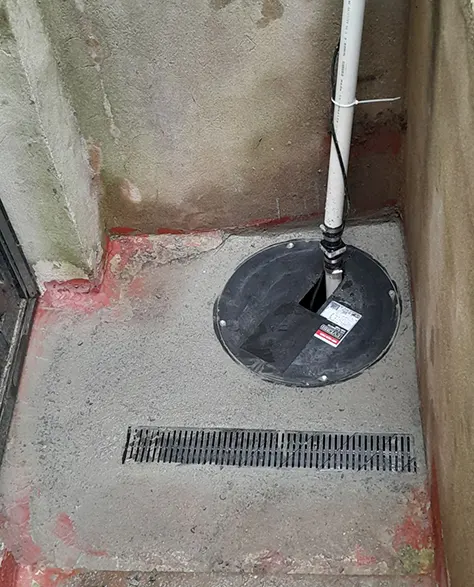
Where there is no pit, we cut and install one properly, connected to the drainage so it actually collects water rather than just sitting in the floor.
Where the water goes matters as much as getting it out. Discharge lines that dump at the foundation are simply recirculating water back into the soil you are pumping it out of.
Two small components that cause a disproportionate share of pump failures. Both are cheap to replace and expensive to ignore.
Discharge lines freeze in a Chicago January, and a blocked line means the pump runs against a closed pipe until it burns out. Proper routing and freeze relief prevents it.
High water alarms and monitoring that tells you the pump has failed before the water reaches your floor rather than afterward.
Signs Your Chicago Sump Pump Needs Attention
Underpinning may be needed when foundation settlement, structural movement, or soil instability threatens the stability of your Chicago home.
✔ The pump runs constantly, or cycles on and off rapidly
✔ The pump has never run, even during heavy rain
✔ Grinding, rattling or unusually loud operation
✔ The pump runs but the water level in the pit does not drop
✔ Visible rust or corrosion on the pump housing
✔ The float switch sticking or hanging up against the pit wall
✔ Water in the basement despite the pump appearing to work
✔ The pump is more than seven years old
✔ No battery backup installed
✔ The discharge line ends within a few feet of the foundation
✔ The pit has no lid, or is full of silt and debris
✔ Water flowing back into the pit after the pump shuts off
✔ The pump is plugged into an extension cord or a shared outlet
✔ The basement flooded during a storm that also caused a power outage
Two of these are opposite symptoms with the same conclusion. A pump running constantly in dry weather usually means groundwater is arriving from somewhere it should not be, or the check valve is letting water flow back into the pit. A pump that has never run while the floor gets wet usually means water is not reaching the pit at all, because the drain tile feeding it is broken or blocked. Either one means the system is not working, even though only one of them looks like a problem.
Why Chicago Is Hard On Sump Pumps
The storms and the outages arrive together. Chicago’s severe summer thunderstorms bring high winds and lightning alongside heavy rain. Those winds take down power lines. So the hour when groundwater is arriving fastest is frequently the hour with no electricity in the house. A pump without backup power is protection that switches itself off exactly when it is needed. This is not a rare scenario here, it is a normal summer.
The clay delivers water in surges. Dense glacial clay does not absorb water steadily, it saturates and then sheds. Chicago storms drop large volumes in short bursts, and the spring thaw releases an entire winter of accumulated moisture across a few days. A pump that handles ordinary rain comfortably can be overwhelmed by a thaw, which is why sizing matters and why March is when we take the most failure calls.
Winter freezes the discharge. A discharge line running above grade or terminating at a low point will freeze solid in a Chicago January. The pump then runs against a blocked pipe, cannot move water, overheats and burns out. The homeowner finds out during the next thaw, when the frozen line is also the reason the basement floods.
Combined sewers rule out the easy discharge route. Much of Chicago runs combined storm and sanitary sewers, and discharging a sump into that system is generally not permitted and would be counterproductive anyway during the storms that overwhelm it. Discharge has to be routed properly above ground and far enough from the house that the water does not simply return.
Old pumps are everywhere. A residential pump typically lasts seven to ten years. Chicago’s housing stock is old, ownership turns over, and a great many basements are protected by a pump that was installed by a previous owner and has never been tested since.
Battery Backup Or Water Powered Backup?
Once you accept that a backup is necessary, there are two ways to provide it, and they suit different houses.
Battery backup is a second pump with its own DC motor, powered by a deep cycle battery that charges off household current and takes over automatically when the primary fails or the power drops. It works anywhere, it does not depend on any other utility, and a properly sized system will run for many hours of intermittent pumping through an outage. The limitation is the battery itself, which needs replacing every three to five years and which will eventually run flat in a prolonged outage.
Water powered backup uses municipal water pressure to drive an ejector that pumps the sump water out, with no electricity involved at all. It runs indefinitely as long as city water pressure holds, which makes it genuinely attractive for long outages. It requires a municipal water supply, it consumes water while running, and local plumbing codes and backflow prevention requirements apply.
What usually decides it in Chicago. Battery backup covers the great majority of situations and is the standard installation. Water powered is worth considering where a homeowner is away from the property for long stretches, where outages in that area tend to run long, or where nobody will be around to notice a battery has drained.
The point we would make regardless. A backup system that is never tested is not a backup system. Batteries lose capacity quietly, float switches stick, and a unit that has sat untouched for four years frequently fails on the one night it matters. Test it twice a year, or have it tested when the primary pump is serviced.
How It Works
1
Free Inspection
We assess the existing pump and pit, test operation under load, check the check valve, float and discharge routing, and look at where the water is actually arriving from.
2
Photos And Explanation
You see what we found, explained plainly, including whether the problem is the pump itself or the drainage feeding it.
3
Written Estimate
Itemized and clear. Pump specification, backup system, discharge routing, price and timeline agreed before anything begins.
4
Installation And Testing
Installed properly on a dedicated circuit, discharge routed correctly and protected against freezing, then tested under load in front of you. Site cleaned and the work documented.
30 Year's Experience
Experience you can trust
GOOGLE 4.9/5 ★★★★★
Real results. Real people.
Licensed, Bonded & Insured
Fully covered, fully accountable