
Foundation Repair Chicago
RESTORE STRENGTH AND STABILITY
Cracked, settling, shifting and bowing foundations repaired properly. We find out what is actually moving before we fix it, so the repair holds.
- Home
- Foundation Repairs
The Crack Is The Symptom. Something Is Moving.
A crack in a foundation wall is not really the problem. It is the evidence that something underneath or outside your foundation has shifted, and until you know what shifted and why, repairing the crack achieves very little.
In Chicago, the cause is almost always the soil. Glacial clay does something unusual. It swells when it absorbs water and shrinks as it dries out, and it does this with enough force to move a house. Through a wet spring the saturated clay pushes inward against your basement walls. Through a dry summer it contracts and pulls away, leaving your footings less supported than they were. Repeat that cycle across thirty or forty years and the foundation does not end up where it started.
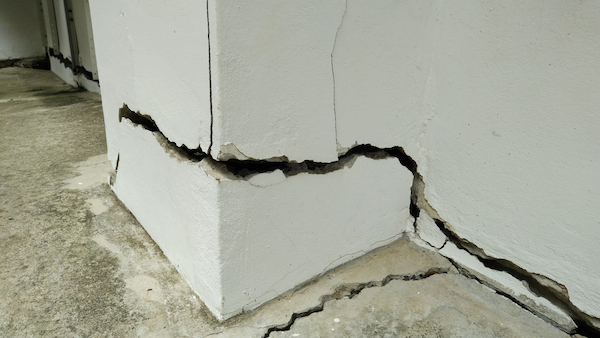
That is why foundation problems in Chicago rarely stay still. A vertical crack from curing shrinkage may be stable and harmless. A horizontal crack, a stair step crack through block, or a wall that has started to lean inward is a wall actively losing against the pressure outside it, and those get worse every wet season.
The repair has to match the cause. Sealing a crack does nothing if the footing is still settling. Installing piers does nothing if the real issue is lateral soil pressure against the wall. We diagnose what is happening first, and then repair it.
Chicago Basements Waterproofing & Foundation has been doing exactly this for 30 years across the city’s bungalows, two flats, greystones and suburban homes.
Book Your Free Inspection
Our Foundation Repair Services
Full depth polyurethane and epoxy injection that seals the water pathway and bonds the concrete back to structural strength, rather than skimming over the surface.
Carbon fiber straps, steel I beams or wall anchors depending on how far the wall has moved and what it is built from. Stops further movement and, in some cases, recovers part of it.
Where the foundation is sinking because the soil beneath it cannot carry the load, helical or push piers transfer that weight down to stable load bearing soil.
Extending and strengthening an existing foundation to reach stable soil or carry additional load. Common on older Chicago homes with shallow original footings.
Rebuilding or repairing deteriorated concrete block and masonry foundations, including the stair step cracking that block walls develop under lateral pressure.
Repairing and reinforcing failing footings, which is where a settlement problem usually actually lives.
Cracked, heaving or sinking basement slabs repaired or releveled.
Because water pressure is what caused most of the movement in the first place. Repairing a foundation without addressing the drainage means watching it happen again.
Signs Your Chicago Foundation Needs Repair
✔ Horizontal cracks running across a foundation wall
✔ Stair step cracking through block or brick
✔ A basement wall that is bowing, bulging or leaning inward
✔ Vertical cracks that are widening over time
✔ Diagonal cracks in drywall above doorways and windows
✔ Doors and windows that stick, jam or no longer close square
✔ Floors that slope, sag or feel uneven underfoot
✔ Gaps opening between walls and ceilings, or walls and floors
✔ Visible separation between the chimney and the house
✔ Cracked or separating exterior brickwork
✔ Nails popping out of drywall
✔ A gap opening between the garage floor and the wall
✔ Water entering through a crack that used to be dry
Two of these are urgent. A horizontal crack and a bowing wall both mean the wall is failing against soil pressure from outside. Unlike a vertical shrinkage crack, they do not stabilize on their own. Every wet spring and every freeze pushes them further, and a wall that has moved past a certain point can no longer be stabilized in place and has to be rebuilt.
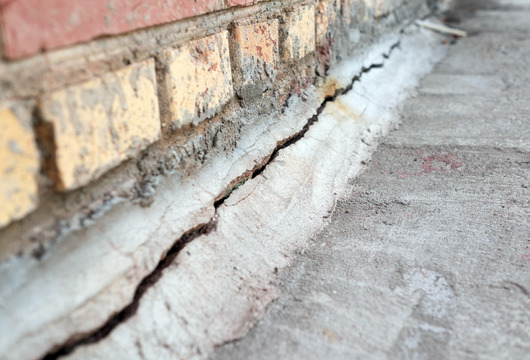
Common Causes of Foundation Movement
Clay expands and contracts with enough force to move a house. Glacial clay swells when it takes on water and shrinks as it dries. Through a saturated Chicago spring that expansion presses inward against basement walls with real force. Through a dry August the same clay contracts and withdraws support from under the footings. Your foundation is squeezed in one season and undermined in the next, every year.
Freeze thaw works on it from the top. Water in the soil and in existing cracks freezes and expands dozens of times each winter. Frost heave lifts sections of ground and lets them drop again, and every cycle opens existing cracks slightly further.
Backfill was never as stable as the ground around it. The soil returned to the excavation when your home was built stays looser and more compressible than the undisturbed clay beyond it. It settles differently over decades, which is why foundation movement so often shows up on one corner or one elevation rather than uniformly.
Older footings were built to older standards. A large share of Chicago’s housing predates 1940. Footings on these homes are frequently shallower and narrower than would be required today, and many sit above the frost line rather than below it. They were adequate for the loads and the understanding of the time. They are less forgiving of a century of clay movement.
Mature trees pull the soil dry. Chicago’s older neighborhoods have large mature trees close to houses, and a single mature tree draws a significant volume of water out of the surrounding clay through summer. That localized drying causes localized shrinkage, and localized shrinkage causes differential settlement on that side of the house.
A foundation moving in Chicago is not evidence that the house was badly built. It is the predictable result of what this soil does over time. What matters is catching it before the movement goes past the point where stabilization is still an option.
Stabilize, Repair Or Rebuild?
Foundation work gets quoted three very different ways, and the difference in price is substantial. Here is what separates them.
Stabilization stops further movement without attempting to reverse what has already happened. Carbon fiber straps on a wall that has bowed less than about two inches, or wall anchors where there is yard access to install them. The least invasive and least expensive option, and entirely appropriate when the wall is sound but under pressure. The crack stays where it is, it just stops getting worse.
Structural repair actively addresses the movement. Steel I beams on a wall that has moved further. Helical or push piers driven to load bearing soil under a settling foundation, which can lift and relevel as well as support. More work, more cost, and the right answer when stabilization would only be delaying the inevitable.
Rebuild becomes necessary when a wall has deteriorated or displaced past the point where it can be saved. Severely spalling block, a wall that has moved several inches, or masonry that has lost structural integrity. Nobody wants this quote, which is exactly why catching problems early matters so much.
The honest part. Most Chicago foundation problems we are called to could have been stabilized at a fraction of the eventual cost if they had been looked at three or four years earlier. A wall at one inch of deflection is a straightforward job. The same wall at three inches is a different conversation entirely.
We will tell you which category your foundation is in, show you the measurements, and tell you honestly when something can be monitored rather than repaired right now.
How It Works
1
Free Inspection
We inspect the foundation walls inside and out, measure wall deflection, check floor levels, look at the exterior grade, drainage and tree proximity, and assess what is actually causing the movement.
2
Photos And Explanation
You see what we found, with photos and measurements, explained plainly. You will know what is moving, why, and how fast.
3
Written Estimate
Itemized and clear. Scope, engineering where required, price and timeline agreed before anything begins.
4
Repair And Cleanup
Work carried out properly, your property protected throughout, site cleaned on completion, and the finished repair photographed. Then it is warranted.
30 Year's Experience
Experience you can trust
GOOGLE 4.9/5 ★★★★★
Real results. Real people.
Licensed, Bonded & Insured
Fully covered, fully accountable